Posts

Showing posts with the label Monetary policy

Could a central bank rely on the emerging 2nd generation NK models before the 2008 financial crisis?

Image
Why is it interesting? The comparison shows that central banks have to deal with model uncertainty and that different models imply very different responses in key economic variables. Many central banks included second-generation New Keynesian models in their suite of models prior to the Great Recession, mainly due to the improved empirical fit of these models relative to the early small-scale models. What to do on the MMB? Models: NK_RW97, NK_IR04, US_ACELm, US_SW07 Policy Rules: Gerdesmeier & Roffia (2004) Shocks: Monetary Policy Shock Variables: Inflation, Interest, Output What is interesting? The impulse responses peak on impact, returning only slowly to their non-stochastic steady state values afterwards. This is at odds with empirical VAR evidence, which suggests that both output and inflation exhibit a hump-shaped response to a monetary policy shock. Medium-size DSGE models of the second generation induce such hump-shaped impulse responses by adding capit...

Does the more accommodative monetary policy lead to stronger fiscal policy effects?

Image
Why is it interesting? This comparison highlights the importance of monetary policy accommodation for fiscal policy effects. It compares the impact of government spending by looking at different central bank reaction functions - model-specific estimated rule from Cogan et al. (2010) and the much more accommodative user-specified rule (as in Bernanke et al. (1999)) that responds only to lagged values of inflation and the interest rate and does not react to GDP. What to do on the MMB? Models: US_CCTW10 Policy Rules: User specified rule (set 0.9 for interest_t-1 and 0.11 for infation_t-1), Model specific rule Shocks: Fiscal Policy Shock Variables: Inflation, Interest, Output What is interesting? The increase in government purchases induces much stronger effects on aggregate GDP under the user-specified rule. Even in the absence of rule-of-thumb consumers, the GDP upshot exceeds unity in the first 4 quarters. The much more accommodative monetary policy regime allows fo...

Does a different implementation of financial frictions influence monetary policy decisions?

Image
Why is it interesting? The comparison shows the effect of an unanticipated increase in the nominal interest rate of one percentage point for the commonly defined macroeconomic aggregates between different financial frictions. What to do on the MMB? Models: US_CD08, US_CMR14, US_DG08, US_SW07, NK_BGG99 Policy Rules: Smets and Wouters (2007) Shocks: Monetary Policy Shock Variables: Inflation, Interest, Output, Output gap, Consumption, Investment What is interesting? The magnitude, timing and dynamic pattern of responses differ substantially across models. It is particularly striking that the smaller New Keynesian models NK_BGG99 and US_CD08 display much stronger responses of output and inflation and a much smaller response of the nominal interest rate than the medium-size DSGE models US_SW07, US_DG08 and US_CMR14. This diversity of responses to a monetary policy shock stands in contrast to the findings of Taylor and Wieland (2012). The reason is that in these two mode...

Which of the four is the most effective policy rule in a Smets-Wouters world (with financial frictions)?

Image
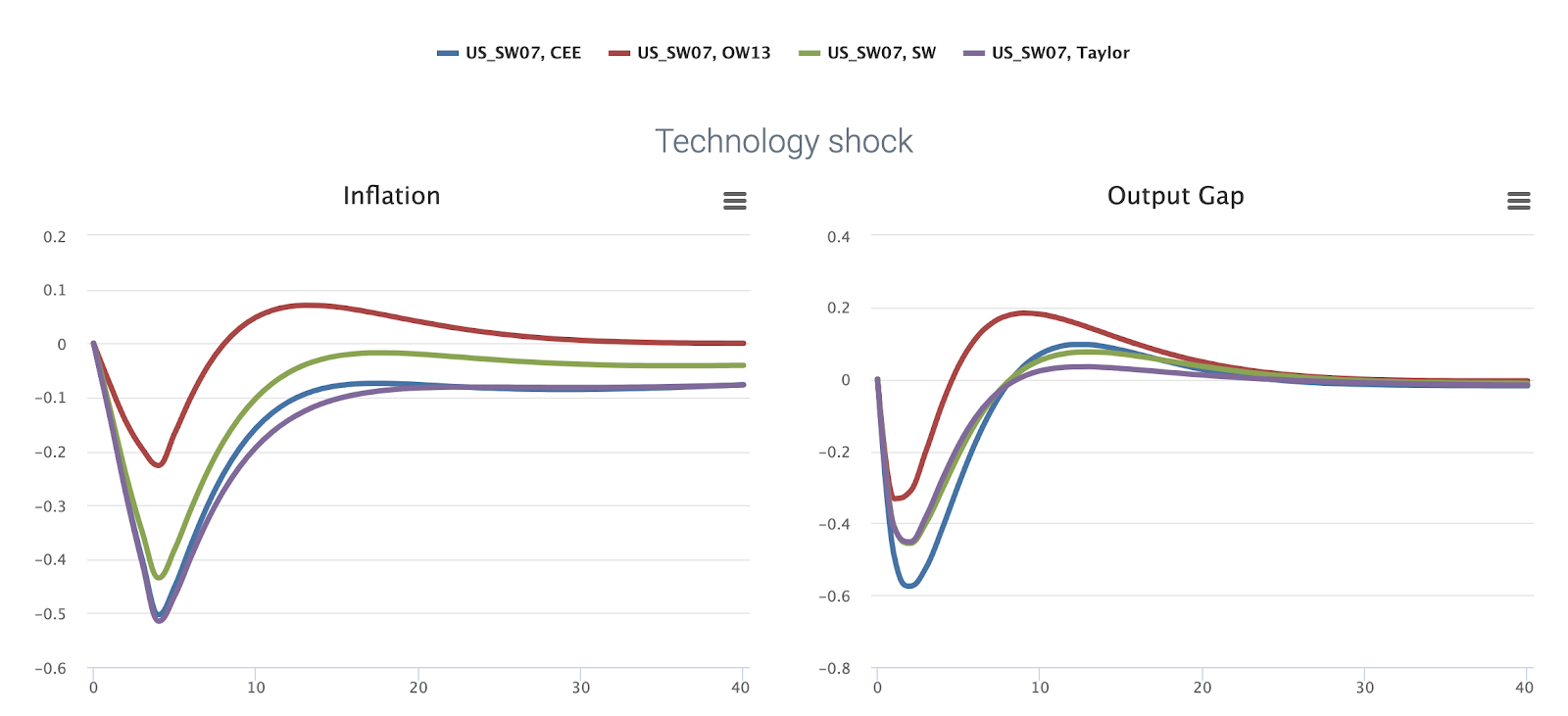
Why is it interesting? A standard recommendation is to avoid surprises in monetary policy since they only generate additional output and inflation volatility. Instead, optimal and robust monetary policy design focuses on the proper choice of the variables and the magnitude of the response coefficients in the policy rule to stabilize output and inflation in the event of shocks emanating from other sectors of the economy. In this comparison we assess how different monetary policy rules perform in two widely used estimated models describing the US economy, the US_SW07 and the US_DNGS15 models, when hit by some other than a monetary or demand shock. What to do on the MMB? This is a one model against multiple rules exercise. Please tick only one model at a time for comparison. Models: US_SW07, US_DNGS15 Policy rules: Christiano et al. (2005) rule, Orphanides and Wieland (2013), Smets and Wouters (2007), Taylor (1993) Shocks:   Technology shock, Risk premium shock (for US_SW07), ...

What is the effect of a monetary policy shock if models differ in structure, estimation and data vintage?

Image
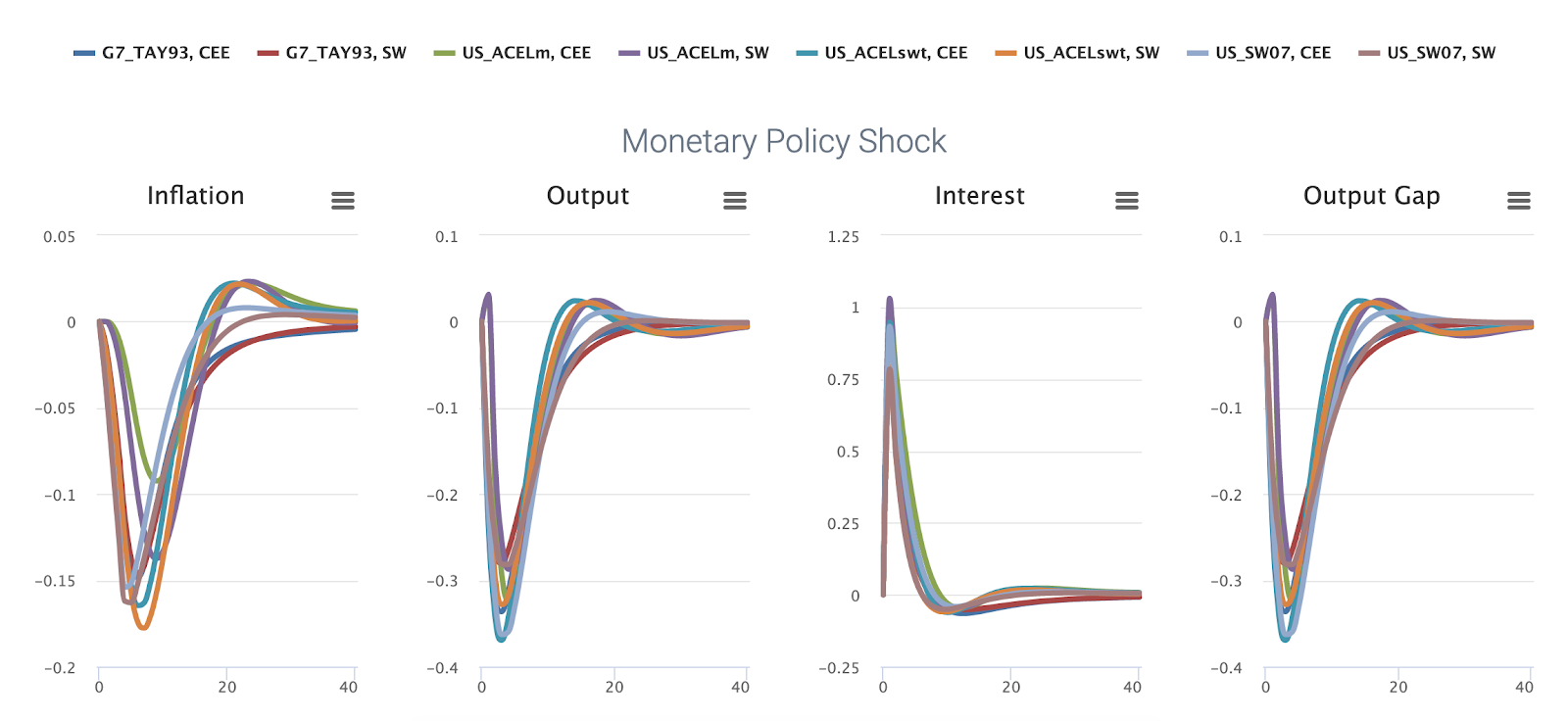
Why is it interesting? This exercise aims to compare the second generation DSGE models (US_SW07, US_ACELm, US_ACELswt) and the model in G7_TAY93, as these models differ in terms of economic structure and parameter estimates, which are based on U.S. data. What to do on the MMB? Models: G7_TAY93, US_SW07, US_ACELm, US_ACELswt Policy rules: Smets & Wouters (2007), Christiano et al. (2005) Shocks:   Monetary Policy Shock Variables: Inflation, Interest rate, Output, Output Gap What is interesting? Surprisingly, the effect of the policy shock on real output and inflation given a common policy rule is very similar in the four models. The quantitative implications for real output in G7_TAY93 and US_SW07 are also almost identical. The outcome under US_ACELm initially differs slightly from the other two models. In the period of the shock we observe a tiny increase in output, while inflation does not react at all. From the second period onwards output declines t...

What if our perception on the structure of the economy is seriously biased?

Image
Why is it interesting? What if our perception on the structure of the economy is seriously biased? This question motivates the comparison of four models adopted by the ECB against one policy rule, to investigate if their impulse responses would be divergent. What to do on the MMB? Models: EA_AWM05, EA_CW05fm, EA_CW05ta, EA_SW03 Policy Rules: Gerdesmeier & Roffia (2004) Shocks: Monetary Policy Shock Variables: Inflation, Output gap What is interesting? EA_AWM05 shows the highest degree of persistence in inflation and output gap while EA_SW03 the lowest; EA_CW05fm and EA_CW05ta are in between. (CH) Reference:  Küster K., & Wieland V. (2005) Edited by Huang C.C.