Posts

Showing posts with the label US

Does the more accommodative monetary policy lead to stronger fiscal policy effects?

Image
Why is it interesting? This comparison highlights the importance of monetary policy accommodation for fiscal policy effects. It compares the impact of government spending by looking at different central bank reaction functions - model-specific estimated rule from Cogan et al. (2010) and the much more accommodative user-specified rule (as in Bernanke et al. (1999)) that responds only to lagged values of inflation and the interest rate and does not react to GDP. What to do on the MMB? Models: US_CCTW10 Policy Rules: User specified rule (set 0.9 for interest_t-1 and 0.11 for infation_t-1), Model specific rule Shocks: Fiscal Policy Shock Variables: Inflation, Interest, Output What is interesting? The increase in government purchases induces much stronger effects on aggregate GDP under the user-specified rule. Even in the absence of rule-of-thumb consumers, the GDP upshot exceeds unity in the first 4 quarters. The much more accommodative monetary policy regime allows fo...

Does the population share of rule-of-thumb consumers matter for the size of the fiscal multiplier?

Image
Why is it interesting? This comparison evaluates the sensitivity of fiscal policy effects to the parameters governing household consumption choices. It compares the effects of government spending depending on the share of Keynesian-style rule-of-thumb households (w) – those that simply consume all current disposable income. Three cases are considered – share of 0 percent (all consumers are forward-looking and base their decision on expected life-time income), 26.5 percent (estimated value within the model) and 50 percent (an upper limit of estimates found in the literature on the U.S. economy). What to do on the MMB? Go to "Menu" > "Edit Rules/Models" and click the plus icon to add two additional models (in this example, US_CCTW100 and US_CCTW100265). Then copy the json and the mod file from US_CCTW10 and paste them in the two new models. Change model names in the json and mod files of the two new models. Set "omega" to 0 and 0.265 in the mod file o...

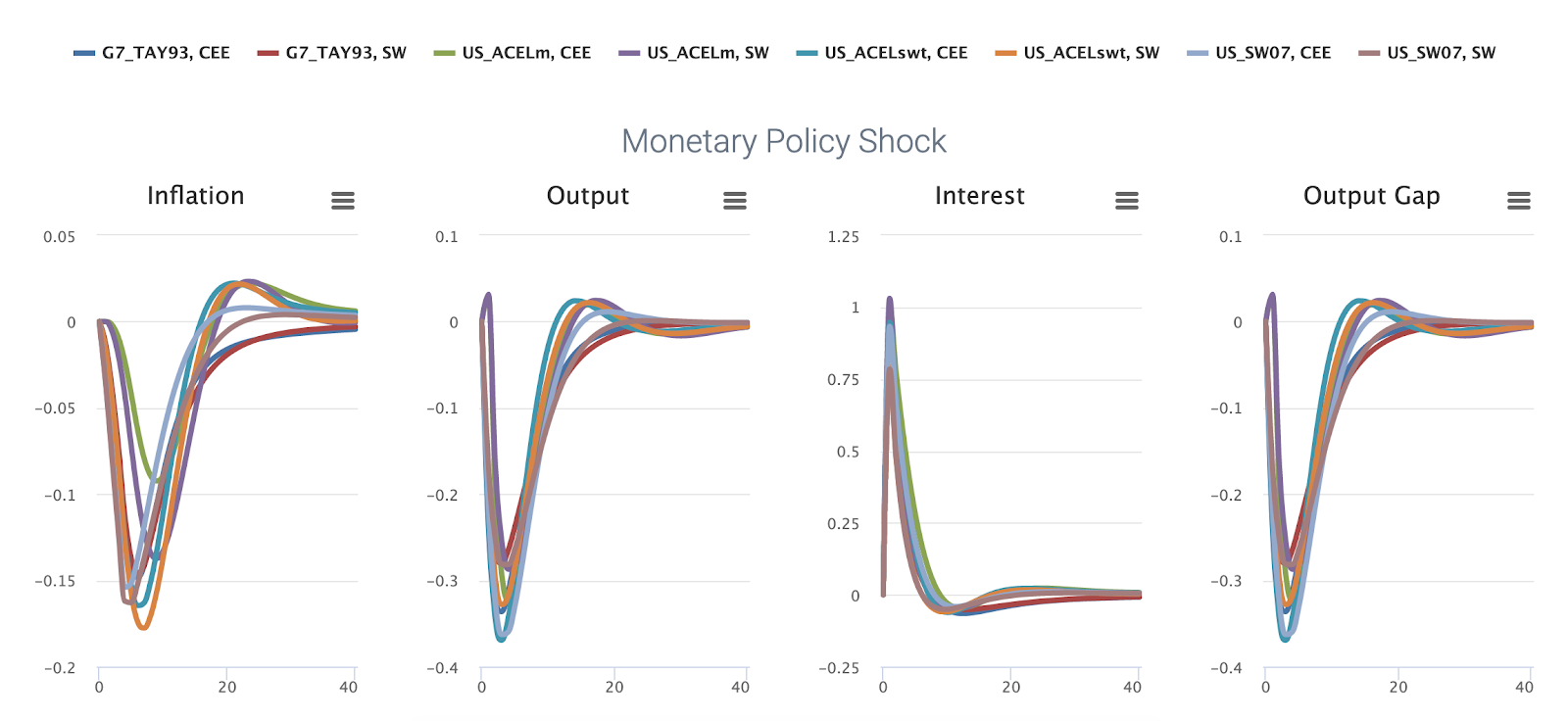
What is the effect of a monetary policy shock if models differ in structure, estimation and data vintage?

Image
Why is it interesting? This exercise aims to compare the second generation DSGE models (US_SW07, US_ACELm, US_ACELswt) and the model in G7_TAY93, as these models differ in terms of economic structure and parameter estimates, which are based on U.S. data. What to do on the MMB? Models: G7_TAY93, US_SW07, US_ACELm, US_ACELswt Policy rules: Smets & Wouters (2007), Christiano et al. (2005) Shocks:   Monetary Policy Shock Variables: Inflation, Interest rate, Output, Output Gap What is interesting? Surprisingly, the effect of the policy shock on real output and inflation given a common policy rule is very similar in the four models. The quantitative implications for real output in G7_TAY93 and US_SW07 are also almost identical. The outcome under US_ACELm initially differs slightly from the other two models. In the period of the shock we observe a tiny increase in output, while inflation does not react at all. From the second period onwards output declines t...